Research on the move
Background research, experiments and telemetry collection can continue while driving. Questions and interaction-demanding prompts wait until the vehicle is stopped.
The journey
From a tiny Arduino diagnostic display to a customizable Android cockpit and developer platform. Explore the journey behind Dynamic Dash.
The current device interface brings years of work into one personal cockpit.
A device-wide connection between the vehicle, Codex and deeper desktop analysis.
Monitor the device remotely, interact with its interface and collect screenshots, CAN logs, markers and GPS routes. Transfer the captured material to a home PC for custom analysis and further experiments.
Background research, experiments and telemetry collection can continue while driving. Questions and interaction-demanding prompts wait until the vehicle is stopped.
The relay workflow is implemented and entering in-vehicle validation. On-device status keeps research activity visible. CAN capture in this workflow is read-only.
Voice interaction is in development: Whisper speech-to-text will relay spoken requests to Codex, with Google’s text-to-speech providing audible replies.
Born during the COVID era, Dynamic Dash grew through successive hardware and software generations into today’s Android head unit.
Arduino
The project began by reading diagnostic messages with an Arduino and displaying them on a tiny screen.
Windows · Surface · Noesis
The interface moved to Windows, using Noesis on a Surface.
pi-top · Raspberry Pi
The next stage explored the cockpit on a pi-top Raspberry Pi platform.
Android · Dynamic Dash
That ongoing work became the current Android system: vehicle-connected data, a custom launcher, instrument clusters, music and an extensible platform.
Working product features, new integrations and current system-build development.
42 clusters, music, maps, driving records, Android Workspace, customization and first-class .NET plugins support everyday use and deeper development.
Manage plugins and inspect device health from a phone or PC. A screen is optional for a plugin-led setup.
Relay-connected remote monitoring, device UI interaction, screenshots, CAN captures and markers, GPS route saving and transfer to a home PC are implemented. Background research continues while driving; questions wait until stopped. In-vehicle validation is the next step.
Spotify, Android Auto, UDS and guided CAN discovery extend the existing platform.
Current integrations and product development.
Spotify and Android Auto integration are in development.
UDS, guided signal hunting and extended signal logging are in development. Long coding is a future extension.
Product packaging, compatibility documentation and ongoing QA continue as Dynamic Dash moves towards a potential commercial release.
Whisper speech-to-text and Google’s text-to-speech are being integrated for spoken requests through the relay to Codex and audible replies. End-to-end validation is still ahead.
Working features, future additions and new system builds each have their own place in the product roadmap.
The feature guide brings together everyday cockpit use, personalization, recording and analysis, headless operation and development.
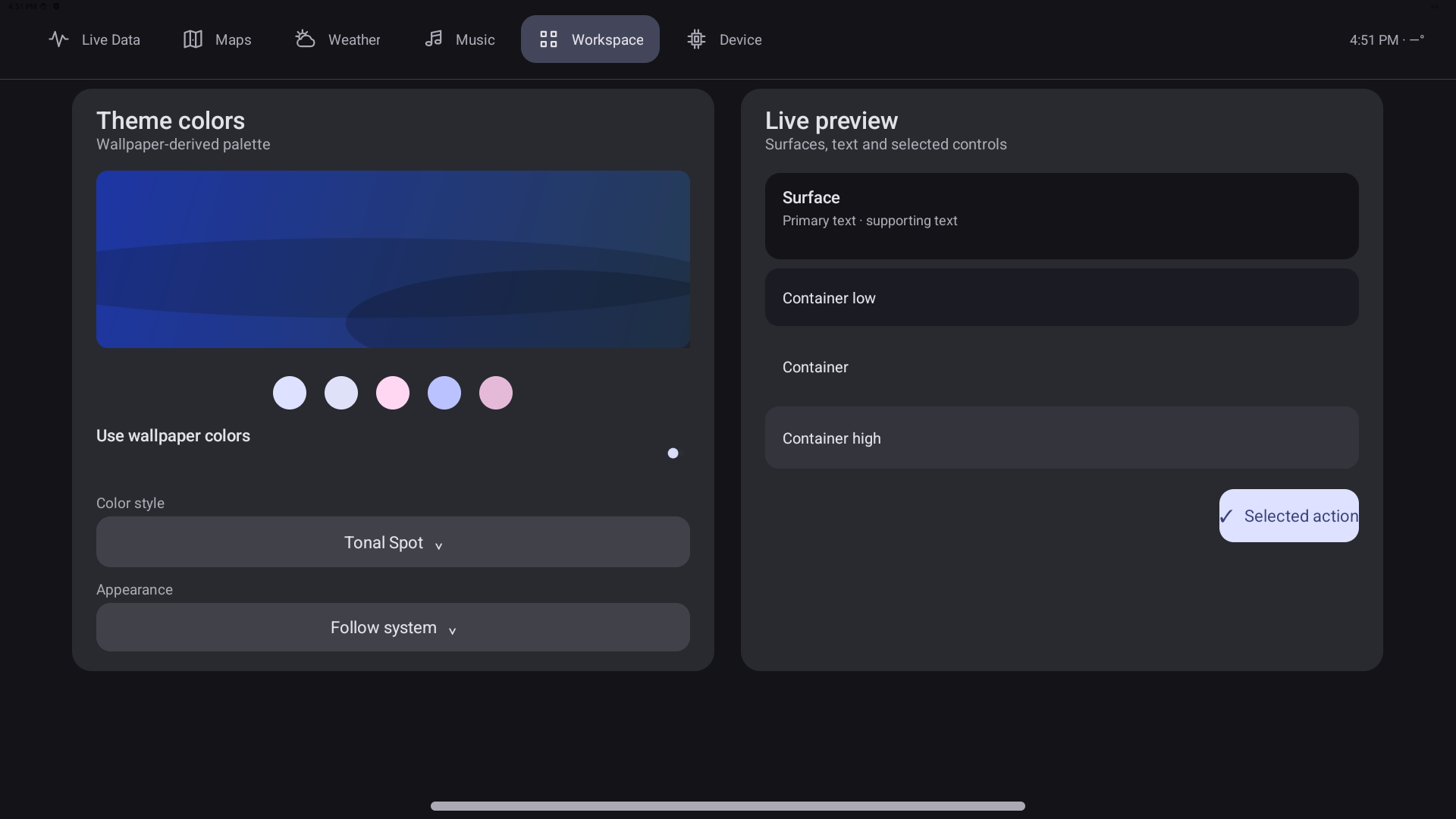
Device screenshots show implemented screens. Each image is a capture of a particular state; an idle or preview display does not define the limits of the feature.
Availability of new integrations is shown alongside those features. No release date or commercial availability is announced.